Custom Sublimated Polos for Business, Golf & Teams
Fully custom sublimated polo shirts for businesses, golf events, uniforms, and teams — cut and sewn around your brand on Butcher Golf garment templates, never decorated blanks.
25 Pieces
Minimum per approved design
~3 Weeks
Production after final artwork approval
Men's & Women's
Mixed in one design
No Embroidery
Cut-and-sew dye-sublimation only
Why Businesses Choose Butcher Golf For Custom Sublimated Polos
Fully custom printed design
Artwork is printed into the fabric and cut to your garment, not applied to a stock blank.
25-piece minimum
One approved design, 25 pieces — sized for a department, a team, or an event.
Men's and women's sizes mix
Three-button men's polos and buttonless V-neck women's polos in one compatible design.
Standard custom design included
Hands-on design support is part of project pricing, not an add-on line item.
Standard shipping included
Standard delivery to one U.S. address is included in project pricing.
Production-proof photos
You review production-proof photos before full production begins.
~3 weeks after artwork approval
Most finished orders are produced and delivered in about three weeks after final artwork approval.
What A Custom Sublimated Polo Is
A custom sublimated polo is a polo shirt built from printed fabric: artwork is designed to the shape of the garment's panels, printed and transferred into polyester-based performance material with heat and pressure, and only then cut and sewn into a finished polo or golf shirt. The design is part of the fabric itself, not a decoration added on top. Butcher Golf builds sublimated polos this way for every project, on established garment templates, at a 25-piece minimum per approved design.
Butcher Golf makes custom sublimated golf polos for corporate tournaments, outings, sponsor teams, and client golf days — see corporate golf tournament apparel for event-specific planning. We also create custom dye sublimation polo shirts for employee uniforms, sales teams, and client-facing business use, covered in more depth in employee uniform programs.
That order of operations is the whole point. Decoration methods work on a garment that already exists, which limits branding to whatever area a machine can reach. When the fabric is printed first, the entire garment is available as design space — body, sleeves, collar, placket, cuffs, and the transitions between them. Our guide to cut-and-sew custom apparel covers how each of those panels is planned, our comparison of sublimation vs. embroidery explains when each method is the right choice, and the dye-sublimation process guide walks through printing, cutting, and sewing.
Standard custom design and standard shipping are included in project pricing. Most finished orders are produced and delivered approximately three weeks after final artwork approval, subject to project requirements and production scheduling.
What Sublimation Makes Possible
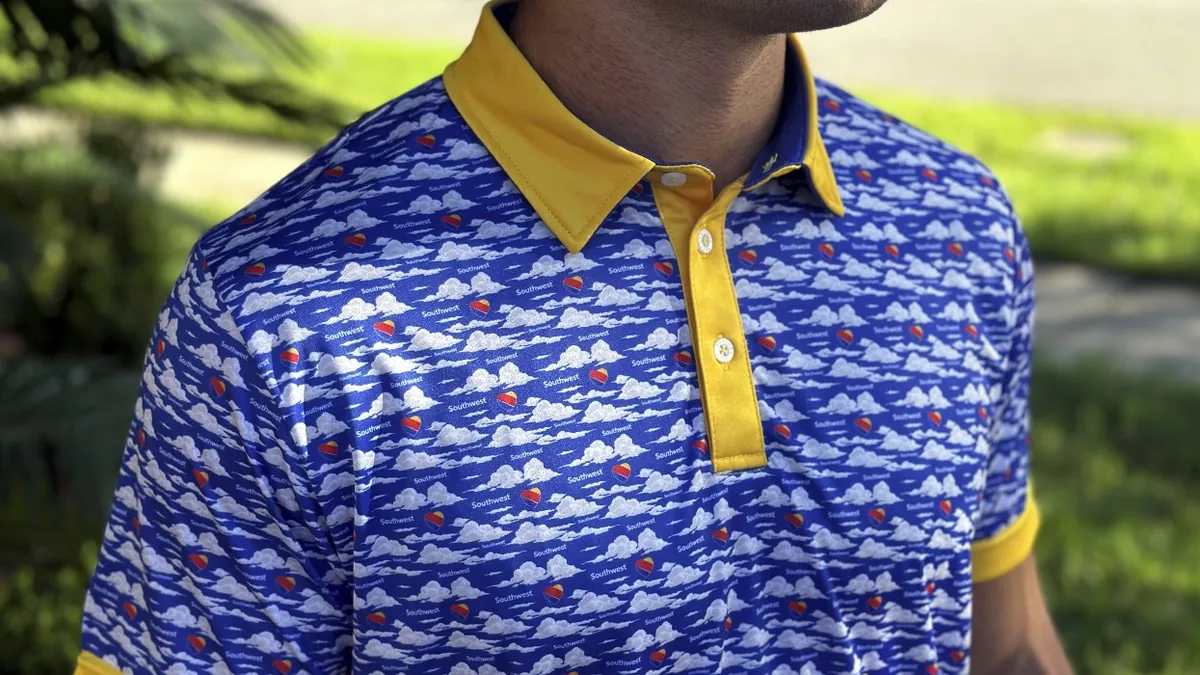
Garment-wide patterns. A repeat built from your logo mark can run across the full body rather than stopping at a decoration zone. See our guide to branded pattern design for how those repeats are built, scaled, and applied.
Multiple colors without added cost per color. Because the design is printed, a five-color palette is a design decision rather than a production surcharge.
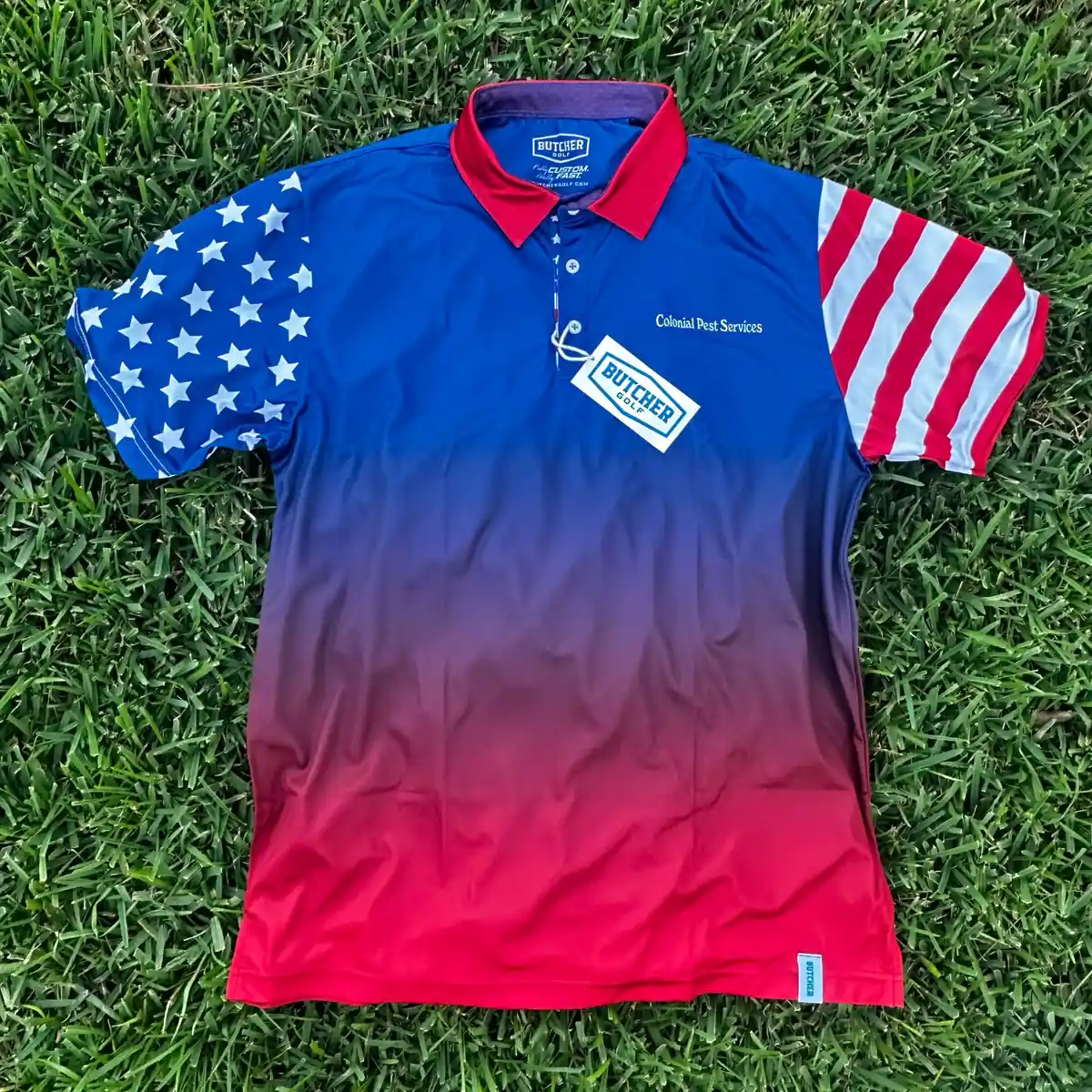
Gradients and ombre transitions. Color can shift across a body panel or fade from shoulder to hem in ways stitching cannot reproduce.
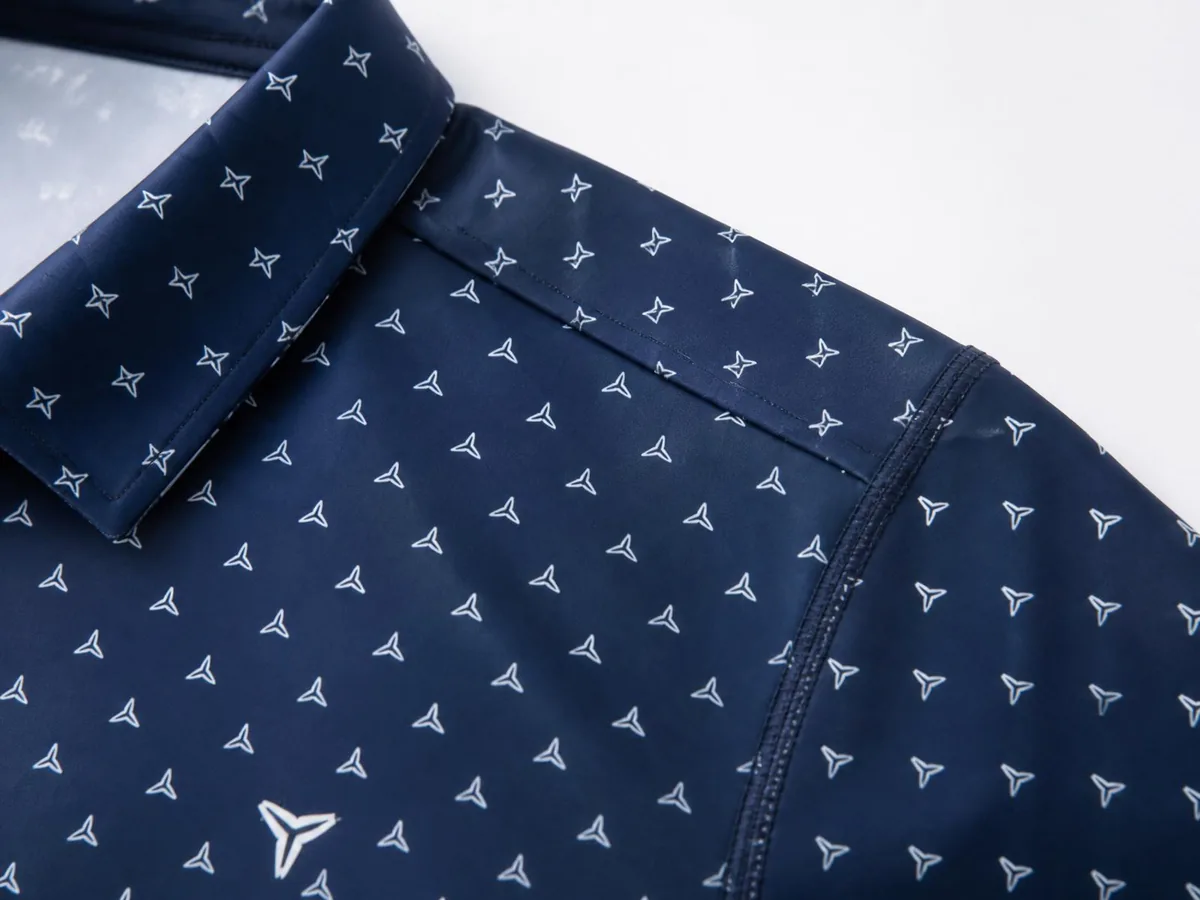
Subtle motifs. Small-scale marks read as texture at a distance and reveal the brand only when someone looks closely.
Panel-specific treatments. A patterned body with solid sleeves, a contrast collar, a color-blocked placket, or accent cuffs — each panel can be treated independently.
Why It Looks Different From A Decorated Blank
Put a fully custom sublimated polo next to a stock blank with an applied logo and the difference is immediate, even to people who could not explain why.
On the decorated blank, branding is an object on a surface: a defined shape with a boundary, sitting on a garment that was designed for a general market. On the sublimated polo, the brand is the garment. Colors carry through panels, patterns cross seams, and there is no raised element to catch light differently than the fabric around it.
The practical effect is tone. Decorated blanks tend to read as promotional; fully custom garments tend to read as designed apparel. That distinction helps determine whether the result feels like a generic promotional item or a garment designed around the brand. Our article comparing decorated blanks and cut-and-sew performance polos goes deeper on the two approaches, and the buyer's guide to how sublimated polos work walks through fabric, proofing, and ordering.
Already have a concept? If you've generated a polo mockup with ChatGPT or another AI tool, we can rebuild it as production-ready artwork on our real garment templates — see how AI concepts become real custom polos.
Construction And Wearability
These are fully custom cut-and-sew garments, not decorated blanks. The artwork is integrated into the fabric before the garment is assembled.
- Fully custom cut-and-sew construction using dye sublimation
- Artwork integrated into the fabric before assembly
- Design coverage across body, sleeves, collar, cuffs, and placket
- 25-piece minimum per approved design
- Compatible men's and women's sizes can be mixed within one design
- Suited to business settings, client-facing teams, golf events, and uniforms
Because the dye is bonded into the fibers rather than layered on top, there is no stiff decorated panel and no heavy patch area where the artwork sits.
Decisions You'll Make With Us
Pattern scale
Subtle scale keeps a design executive-appropriate: the pattern reads as texture and the brand is a close-up detail. Medium scale is the everyday middle ground for team apparel. Bold scale is built to be seen — a good fit for tournaments, booths, and spectator-facing events.
All-over versus strategic accents
An all-over print commits the full garment to the design. Strategic accents place pattern only where it earns attention — a shoulder yoke, a side panel, a sleeve band — and leave the rest solid.
Panels and trim
Collars, sleeves, plackets, cuffs, and body panels can each be handled separately. A contrast collar can pull a secondary brand color forward; a matched placket can make a bold pattern feel more restrained. Our guide to custom polo color blocking covers each panel in detail, and Pantone and brand color matching explains how those brand colors translate to printed fabric.
Logo placements
Left chest remains the most legible primary placement. Sleeve, back collar, and shoulder placements support it. Choosing one primary and one or two supporting placements almost always looks better than using every available spot.
Men's and women's options
The men's polo is a classic three-button construction with a self-fabric collar. The women's polo is a buttonless V-neck cut for a cleaner neckline. Both can be produced from the same approved design and mixed inside a single 25-piece order, so a team looks coordinated without wearing the same cut.
Where These Polos Get Worn
- Employee uniform programs for customer-facing staff
- Sales teams and account managers in client meetings
- Corporate golf outings, tournaments, and sponsor teams
- Conferences, trade shows, and booth staff
- Company retreats, kickoffs, and team-building events
- Client appreciation gifts and executive gifting
- Associations, schools, and athletic programs
Custom sublimated golf shirts for outings and sponsor events are covered in more depth in corporate golf tournament apparel, and daily-wear rollouts in employee uniform programs.
For projects that need both a warm-weather and a layering piece, polos can be paired with custom quarter-zip design in the same brand pattern. For program-level planning across uniforms, events, and gifting, see custom corporate apparel design.
How Ordering Works
- 01
Share Your Project
Send your logo, brand colors, project details, intended use, estimated quantity, and any in-hand date through the inquiry form.
- 02
Review Your Estimate
You receive a confirmed project estimate based on product, quantity, and design scope.
- 03
Project Start Deposit
A $250 Project Start Deposit moves the project into design and is credited 100% toward your order.
- 04
Design And Artwork Approval
Our design team develops your custom polo artwork with you. Approved artwork defines exactly what gets produced.
- 05
Production Proof And Production
You review production-proof photos, the remaining balance is paid electronically through QuickBooks, and full production begins. Most finished orders are delivered approximately three weeks after final artwork approval.
Start Your Custom Sublimated Polos
Send your logo, colors, and quantity. We'll build fully custom polo concepts around your brand — Fully Custom. Really Fast.
Common Questions
Still deciding? Tell us about your project and we'll answer specifics for your brand.
Start Your Design- What is a custom sublimated polo?
- A polo whose artwork is printed into the fabric using heat and pressure before the garment is cut and sewn. The color becomes part of the polyester-based performance material rather than sitting on top of it as a separate applied layer.
- Are sublimated polos good for company uniforms?
- Yes. Because the artwork is printed into the fabric rather than applied on top, custom dye sublimation polo shirts keep a clean, professional look that suits customer-facing staff, sales teams, and employee uniform programs. The 25-piece minimum per approved design fits department-level rollouts, and reorders are possible.
- Do you make custom sublimated golf polos?
- Yes. Custom sublimated golf polos are a core Butcher Golf product, worn at corporate golf outings, tournaments, sponsor events, and client days. Every polo is fully custom cut-and-sew with the artwork integrated into the fabric before assembly, and every design is built around your brand.
- What is the minimum order for custom sublimated polos?
- 25 pieces per approved design.
- Can men's and women's sizes be mixed?
- Yes. Men's and women's sizes can be mixed within one compatible approved design. The men's polo is a classic three-button construction and the women's polo is a buttonless V-neck.
- Is custom design included?
- Yes. Standard custom design is included in project pricing. You send your logo, brand colors, and direction, and our design team develops the artwork with you.
- Is shipping included?
- Yes. Standard shipping is included in project pricing.
- Will I see a production proof?
- Yes. Production-proof photos are standard before full production begins. An in-hand production proof is available as a separate paid option.
- How long does production take?
- Most finished orders are produced and delivered approximately three weeks after final artwork approval, subject to project requirements and production scheduling.
- How do I start an order?
- Send your logo, brand colors, intended use, estimated quantity, and any in-hand date through Start Your Design. You'll receive a confirmed project estimate, then a $250 Project Start Deposit — credited 100% toward your order — moves the project into custom design.
- How is sublimation different from embroidery?
- Embroidery stitches thread onto an existing garment, which works well for compact marks. Dye-sublimation prints artwork into the fabric itself, which allows garment-wide patterns, gradients, and panel-specific designs. Butcher Golf produces cut-and-sew dye-sublimated apparel only; we do not offer embroidery or screen printing.
- Can the pattern be subtle?
- Yes. Pattern scale is a design choice. A tight, small-scale motif reads as texture from across a room and only reveals the brand up close, which is often the right call for executive and client-facing wear.
Related Design Studio Guides
Design Studio
The hub for every Butcher Golf guide on designing fully custom corporate polos and quarter-zips.
Dye-Sublimation Process
A step-by-step look at printing, cutting, and sewing fully custom cut-and-sew apparel.
Custom Apparel Design Process
What to send, how concepts are developed, and what happens between approval and delivery.
Custom Corporate Apparel Design
How brand identity becomes wearable design for uniforms, sales teams, events, and client gifts.
Cut-and-Sew Custom Apparel
How a garment is designed panel by panel before the fabric is printed, cut, and sewn.
Sublimation vs. Embroidery
How the two branding methods differ and which one fits your corporate apparel goal.
Custom Polo Color Blocking
Using collars, sleeves, bodies, cuffs, plackets, and trim as deliberate parts of the design.
Pantone and Brand Color Matching
How Pantone references and brand color standards translate to printed performance fabric.
Branded Pattern Design
How logos, icons, and graphics become wearable repeat patterns at the right scale and contrast.
Design Your Custom Polos
Tell us about your team, your event, and your brand. We'll build polo concepts around it — fully custom, really fast.
Written and reviewed by the Butcher Golf design team. Last reviewed: September 2, 2026.