
How To Prepare Your Logo For Custom Apparel
The best custom apparel projects start with clean brand assets. A vector logo is preferred because it can be resized, repeated, recolored, and placed across garment panels without losing edge quality. When vector artwork is unavailable, the highest-resolution approved file is the next best starting point.
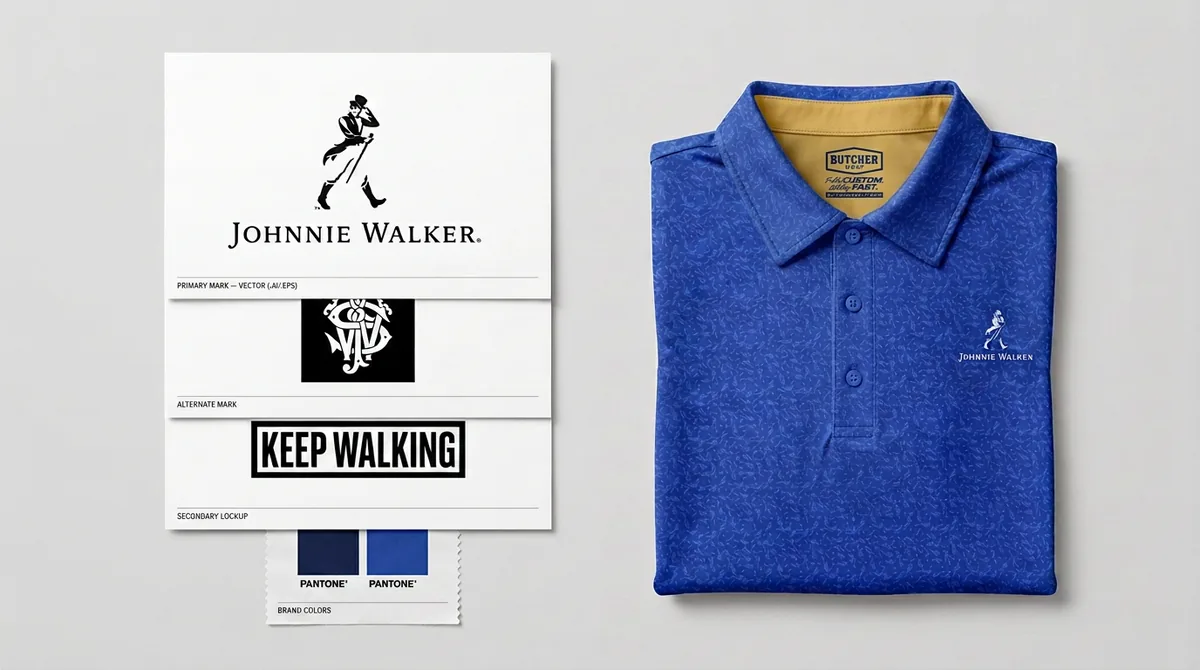
Vector Preferred
Scales without pixelation
Fonts Outlined
Preserves the intended typography
Alternate Marks
Create more design flexibility
Brand Colors
Pantone or documented values are ideal
The Short Answer
Send an EPS, SVG, or vector PDF version of your logo with fonts outlined whenever possible. Include official brand colors, alternate logo arrangements, icon-only marks, one-color versions, reverse versions, and current brand guidelines.
If vector artwork is not available, send the largest and cleanest transparent PNG you have. A high-resolution file may be usable for some applications, and the artwork can be reviewed to determine whether vectorization or cleanup is needed before apparel design begins.
Do not delay the project because you are unsure which file is correct. Send the available options and identify the version your organization currently treats as official. If your starting point is an AI-generated mockup rather than a file, that works too — see how AI concepts become real custom polos.
Why Vector Artwork Is Preferred
A vector logo is built from mathematical paths rather than a fixed grid of pixels. It can be enlarged for a bold garment panel or reduced for a small repeating pattern while keeping smooth curves, sharp corners, and clean type.
That flexibility matters in fully custom apparel because the same brand element may be used in several ways:
- A featured chest or sleeve logo
- A small tonal repeat across the body
- A large graphic integrated into a panel
- A one-color mark on a contrast collar or cuff
- A reverse logo on a dark background
- A supporting icon inside a custom pattern
A low-resolution raster file may look acceptable at email size but break apart when enlarged or repeated. Pixelated edges, compressed color, halos around transparent areas, and distorted proportions become more visible on printed fabric.
Preferred File Formats
EPS
EPS is a common vector format used in professional design and production workflows. It can preserve paths, shapes, and color information when the file was created correctly.
SVG
SVG is a scalable vector format widely used for digital brand assets. It is especially useful for clean logos, icons, and marks with defined shapes.
Vector PDF
A PDF can contain true vector artwork, but not every PDF is vector. A low-resolution image placed inside a PDF remains a low-resolution image. The design team will inspect the file rather than relying on the extension alone.
AI
Adobe Illustrator files may also contain the original vector artwork. They are useful when linked assets are included and fonts have been converted to outlines or otherwise supplied correctly.
Transparent PNG
PNG is a raster format. A large transparent PNG can be useful when vector artwork does not exist, especially for a straightforward featured logo. It is less flexible for extensive resizing, recoloring, or building very small repeats.
JPEG
JPEG should be treated as a fallback. It does not support transparency and often contains compression artifacts. Send the original, largest available file rather than an image copied from a website, document, or social post.
What "Fonts Outlined" Means
A logo may use a typeface that is not installed on another computer. If the text remains live and the font is missing, the design software may substitute a different typeface and change the logo.
Outlining converts the letterforms into vector shapes. The logo no longer depends on the font file to display correctly. This helps preserve the approved spacing, proportions, and typography throughout the apparel-design and production workflow.
Do not outline ordinary website copy or editable documents. This requirement applies to the logo artwork and other finished brand marks being supplied for production.
Send More Than The Primary Logo
The main logo is important, but alternate assets often create the most wearable design options.
A useful apparel brand package may include:
- Primary logo
- Horizontal or stacked logo arrangement
- Icon, monogram, emblem, or symbol without the full wordmark
- Approved one-color logo
- Approved reverse or white logo
- Sub-brand, campaign, event, or sponsor marks
- Tagline artwork
- Brand patterns or graphic elements
- Pantone and digital color values
- Minimum-size and clear-space guidance
An icon may work better than a full horizontal logo inside a repeating pattern. A one-color version may read more clearly on a sleeve. A reverse mark may be required on a dark collar. Providing approved variations lets the designer solve those problems without inventing unofficial versions.
Preparing A Logo For A Repeating Pattern
A mark that works as a large sign does not automatically work as a small fabric repeat. Fine lines, tiny type, detailed gradients, and complex outlines may become difficult to recognize when reduced.
The design team evaluates:
- The simplest recognizable portion of the identity
- Whether small text should remain in the repeating motif
- How much space the mark needs around it
- Whether it can be rotated or offset without appearing incorrect
- Which one-color or tonal version is approved
- How the repeat interacts with a featured chest logo
- Whether the motif remains clear after printing, sewing, and natural fabric movement
Sometimes the full logo is best for the chest while a simplified icon becomes the pattern. That is not a redesign of the brand. It is using the correct approved asset for the scale and purpose.
See how those assets become subtle, medium, or bold branded patterns.
Preserving Logo Accuracy
A production-ready apparel concept should preserve the logo's spelling, proportions, orientation, approved colors, and relationship between elements. The logo should not be stretched to fill a space, compressed to fit a panel, mirrored for symmetry, or redrawn from memory.
When a logo must work near a seam, zipper, placket, or curved body area, the placement should change before the logo itself is distorted. A slightly smaller mark in a clean location is better than a larger mark wrapped awkwardly across construction details.
The same principle applies to patterns. A repeat may wrap naturally with the garment and wearer, but the source mark should remain recognizable and correctly proportioned inside the approved artwork.
What If You Do Not Have A Vector Logo?
Send the best file you have. Useful sources may include:
- The original logo attached to an old email
- A high-resolution transparent PNG
- A PDF from a sign, vehicle, packaging, or print project
- A brand-guideline document
- A file from the designer or agency that created the identity
- An EPS or SVG stored by a printer, sign company, or web developer
Butcher Golf can inspect the assets and explain what is usable. If the artwork requires vectorization or reconstruction before design begins, that requirement and any applicable cost should be confirmed with you first.
Avoid creating a new unofficial logo by tracing a screenshot yourself. It is better to identify the limitation and rebuild from the best available source with approval.
Color Information To Include
Logo files and color standards should be reviewed together. Send Pantone references when available, along with current HEX, RGB, or CMYK values and any documented guidance about primary, secondary, accent, or neutral colors.
The same logo may need a full-color version, one-color version, and reverse version depending on the garment background. Approved color flexibility creates better apparel without weakening the brand.
Our Pantone and brand color matching guide explains how these references translate to printed performance fabric.
Logo Asset Checklist
- Vector EPS, SVG, AI, or vector PDF
- Fonts converted to outlines in final logo artwork
- High-resolution transparent PNG as a backup
- Primary, alternate, one-color, and reverse logo versions
- Icons, monograms, emblems, or approved supporting marks
- Pantone and documented digital color values
- Brand guidelines
- Sponsor or partner logos required for the garment
- Notes identifying which assets are current and approved
- Any restrictions on placement, background, minimum size, or clear space
The complete custom apparel design process shows how these files move from submission to approved artwork.
Common Questions
Still deciding? Tell us about your project and we'll answer specifics for your brand.
Start Your Design- What is the best logo format for custom apparel?
- A vector EPS, SVG, AI, or vector PDF is preferred. Vector artwork can be resized, recolored, and repeated without becoming pixelated. Fonts should be outlined in final logo artwork.
- Can you use a PNG logo?
- A large, clean, transparent PNG may be usable, especially for a straightforward featured logo. It is less flexible than vector artwork for extensive resizing, recoloring, and small repeating patterns.
- Is every PDF a vector file?
- No. A PDF can contain vector paths or a raster image. Placing a low-resolution JPEG inside a PDF does not convert it to vector artwork. The file has to be inspected.
- What happens if our logo needs to be vectorized?
- Butcher Golf will review the supplied files and explain whether cleanup or vectorization is required. Any applicable fee should be confirmed before the additional artwork work begins.
- Should we send alternate logo versions?
- Yes. Icon-only, one-color, reverse, horizontal, stacked, and other approved versions give the designer more flexibility across patterns, collars, sleeves, cuffs, chest placements, and dark or light backgrounds.
Related Design Studio Guides
Branded Pattern Design
How logos, icons, and graphics become wearable repeat patterns at the right scale and contrast.
Pantone and Brand Color Matching
How Pantone references and brand color standards translate to printed performance fabric.
Custom Apparel Design Process
What to send, how concepts are developed, and what happens between approval and delivery.
Custom Corporate Apparel Design
How brand identity becomes wearable design for uniforms, sales teams, events, and client gifts.
Send The Best Brand Assets You Have
You do not need a perfect production package before contacting us. Send the available logo files, colors, and guidelines. We will identify what is ready, what may need cleanup, and how the brand can translate into fully custom apparel.
Written and reviewed by the Butcher Golf design team. Last reviewed: August 6, 2026.